A dental office looks tidy almost by default. The floors are hard, the counters are clear, and everything is built to wipe down.
That’s part of why the cleaning gets misunderstood. Dental practices have two separate cleaning jobs happening in the same building, and they aren’t done by the same people.
One is the work around the dental chair. The other is everything else. If you’re a practice manager looking at a new janitorial service, knowing where that line sits makes it much easier to hire the right company and write a scope that works.
Two Kinds of Surfaces
 The CDC’s guidance for dental settings splits environmental surfaces into two groups. Clinical contact surfaces are the ones touched by gloved hands or likely to get spattered during treatment. Think light handles, bracket trays, dental unit switches, and computer equipment.
Housekeeping surfaces are the rest: floors, walls, sinks, and break areas. CDC describes these as lower risk, because they don’t come into direct contact with patients or instruments.
That difference drives how the cleaning gets divided up.
The Chairside Work Belongs to Your Team
Clinical contact surfaces get handled between patients, by the people who are in the room. The CDC recommends barrier protection on these surfaces where possible, changed between patients, and cleaning followed by disinfection with an EPA-registered product when a barrier isn’t used.
That work is tied to your infection-control plan and your staff’s training. It isn’t something an outside cleaning crew should be stepping into, and a company that offers to take it over without asking about your protocols is a company to be careful with.
A good cleaning company will ask where that line is. It should be written down before the first night of service, so nothing gets cleaned twice and nothing gets missed.
Where the Cleaning Crew Comes In
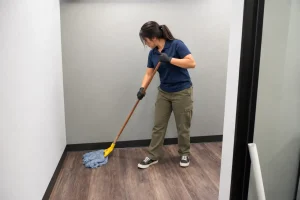
The after-hours work is the part that piles up when nobody owns it. Floors in treatment rooms and hallways. Restrooms. The break room. Trash. Glass at the entrance. The kind of routine commercial cleaning that keeps a building ready to open the next morning.
Housekeeping surfaces in a dental office are still held to a clean standard. The CDC’s guidance is that floors, walls, and sinks in a dental office be cleaned routinely with a detergent and water or an EPA-registered hospital disinfectant/detergent, and cleaned promptly when they’re visibly soiled. For a cleaning crew, the practical takeaway is that process and consistency matter more than heavy chemistry. Use the right product, in the right order, the same way every night.
One thing we see often in clinics is that hard floors look fine until you look at the grout. Treatment rooms and restrooms with tile usually have grout lines where residue settles in and mopping alone doesn’t reach. Periodic hard floor, tile, and grout cleaning takes care of that.
Waiting Room, Front Desk, and Restrooms
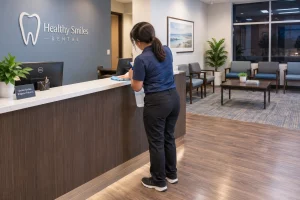 Every patient passes through the waiting room. They sit in the same chairs, use the same pen, and pick up the same clipboard. The front desk counter, door handles, and light switches get touched all day.
These are the areas a nightly crew can do the most for. Wiping and disinfecting shared touchpoints on a set schedule helps keep them in better shape, whether or not they look dirty. Cleaning comes first, because disinfectant doesn’t work well on a surface that still has residue on it. Our crews use hydrogen-peroxide-based, EPA-registered disinfectants, and we leave the product on the surface for the full contact time on the label. You can read more about our disinfection services.
Restrooms are where patients form opinions quickly. If a restroom smells or the floor looks tired, the whole practice gets judged by it.
Keeping Dirty Tools Away From Clean Areas
Cross-contamination usually isn’t something anyone sees happen. A cloth that wiped a restroom should never end up on a waiting room counter.
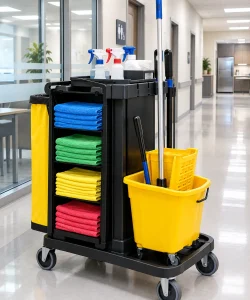
Most commercial crews handle this with color-coded microfiber cloths and dedicated mops for restrooms. It only works if it’s followed every shift. When you interview a cleaner, ask them to describe their system out loud. A good answer is specific. A vague one is a warning.
Regulated Waste Isn’t the Janitor’s Job
Dental offices produce sharps and other regulated waste, and OSHA’s Bloodborne Pathogens Standard requires that it be contained and labeled or color-coded. That is handled by your clinical team and your waste vendor, not by a cleaning crew.
A cleaning company should leave those containers alone, and it helps to say so in the scope. The cleaning crew’s job is the regular trash and the building around it.
What to Ask a Cleaner Before You Hire
 – Which areas do you clean, and which do you leave to our clinical staff?
– How do you keep restroom tools separate from the rest of the building?
– What are you using on shared surfaces, and how long does it stay on?
– How will you handle sharps containers and other regulated waste? (The right answer is that they don’t.)
– Who covers the shift when a regular cleaner is out?
If a company has clear answers, the setup will usually run smoothly. If the answers are fuzzy, the problems tend to show up later.
Clear Lines Make Better Cleaning
The goal isn’t a cleaning company that does everything. It’s one that knows exactly what it’s responsible for and does that part the same way every night.
If you’re looking at cleaning options for a practice in Sioux Falls or the surrounding area, request a quote and Optimal Prime Cleaning Services can look at the building, talk through the scope with you, and put together a plan that fits.
This article is provided by Optimal Prime Cleaning Services for general informational purposes only. It is not medical, legal, or compliance advice. Dental practices should follow their own infection-control policies, current CDC and OSHA guidance, and product label directions.