
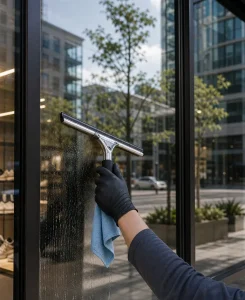
 Glass is the first thing anybody notices about a building and the last thing most cleaning contracts deal with properly.
Part of that is reach. A nightly janitorial crew handles the entry glass, the interior partitions, and the smudges at hand height, because that’s what can be done safely from the floor with a squeegee and a step stool. Everything above that is a different job with different equipment, and in most buildings it quietly never happens until somebody notices the windows have gone gray.
If you’re putting together a cleaning program for a building in the Sioux Falls area, it’s worth knowing where that line sits and what falls on each side of it.
What’s in a Janitorial Scope and What Isn’t
A standard commercial cleaning contract usually covers interior glass that can be reached from the ground. Entry doors, sidelights, conference room partitions, display cases, the smudges around push plates. That’s routine work and it belongs on the nightly or weekly schedule.
What it generally does not cover: exterior glass above the first floor, anything requiring a lift or a rope, window frames and tracks, screens, and mineral staining that a glass cleaner won’t touch.
None of that is a gap in the contract exactly. It’s a separate trade, usually priced separately, and usually scheduled a few times a year rather than weekly. The problem is when nobody spells that out, and everyone assumes it’s covered.
Why Clean Glass Still Looks Cloudy
This is the complaint we hear most about glass, and it usually isn’t a cleaning failure.
Hard water leaves mineral deposits behind every time a droplet dries on glass. Calcium and magnesium stay on the surface after the water evaporates. One cycle is nothing. A sprinkler head that mists the same pane several mornings a week, for a season, builds layer on layer until there’s a chalky film you can feel with a fingernail.
Ordinary glass cleaner does little to it. Glass cleaner is formulated for grease, dust, and fingerprints, and bonded mineral is a different problem entirely. So the window gets cleaned, the cloudiness stays, and it looks like the crew did a poor job.
Left long enough, it stops being a cleaning problem at all. Minerals sitting on glass for years can bond into the surface and etch it, leaving tiny pits that scatter light. At that stage no cleaner reverses it, because the damage is in the glass rather than on it. Restoration can sometimes improve it. Sometimes the pane has to be replaced.
Sioux Falls Water Makes This Worse Than Most Places
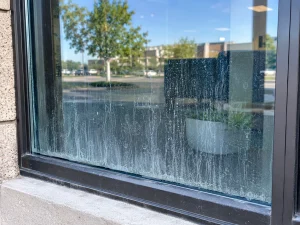 Water hardness varies by source, and it’s a local question rather than a general one.
The City of Sioux Falls publishes an annual water quality report that includes hardness figures. It’s worth pulling the current report for your area rather than assuming, because the number affects how fast deposits build up on glass.
The practical takeaway is about irrigation more than cleaning. If a sprinkler zone is throwing water onto storefront glass or a lower window band every morning, that’s the thing to fix first, because no cleaning schedule outruns it. Walk the building early on a watering day and watch where the heads actually spray. It’s usually obvious, and it’s usually cheap to adjust.
The Anchor Question Most Building Owners Haven’t Been Asked
If your building is tall enough that exterior glass gets cleaned from a rope descent system, federal fall-protection rules put specific responsibilities on the building owner, not just the contractor. Those responsibilities include making sure roof anchorages are rated and certified, and providing that information to the window cleaning company in writing before anyone goes over the edge.
Many owners don’t know this. A window cleaning company that asks for your anchor documentation isn’t creating paperwork. They’re following the same rules, and a company that never asks is one to be careful with.
Most buildings in Sioux Falls are low enough that this never comes up, and the work gets done from the ground or a lift. But if a rope is ever part of the job, confirm the current requirements with your contractor and the OSHA standard before the work is scheduled rather than after.
How Often Glass Needs Doing
There’s no universal number, and anyone who gives you one without seeing the building is guessing.
What actually drives the schedule:
– Which direction the glass faces, and whether it gets afternoon sun that bakes deposits on
– Whether irrigation, roof runoff, or downspout splash reaches any of it
– Street exposure, including winter salt spray along a busy road
– How much of your first impression depends on it, which is a different answer for a storefront than for a warehouse office
A building with clean exposure might be fine twice a year. A storefront on a salted arterial with sprinklers nearby may need more frequent attention just to stay even.
Who Handles the Glass
Exterior and high-access window cleaning is a specialized trade with its own equipment, safety requirements, and insurance needs. It’s rarely the same crew that handles nightly janitorial work.
That means the decision to make is less about who cleans the glass and more about whether it gets scheduled as part of one program or managed as a separate contract. Either can work. What doesn’t work is having the glass fall between two contracts, with nobody responsible for it.
If you’re deciding how to handle it, the questions in this article are a good starting point for any window cleaner you talk to.
The Short Version
Interior glass belongs on the janitorial schedule. Exterior and above-reach glass is its own trade on its own cycle. Cloudiness that survives a cleaning is usually mineral, not technique, and the fix often starts with the sprinklers. And if a rope is ever involved, the anchor certification is the building owner’s responsibility to produce.
If you want the glass handled as part of the cleaning program for your building instead of a loose end nobody owns, request a quote from Optimal Prime Cleaning Services and we’ll look at the building with you.