When you hire a cleaning company for your Sioux Falls facility, you aren’t just paying for shiny floors and empty trash cans. You are paying for a partner who keeps you out of legal hot water. As of 2026, a single serious OSHA violation can cost over $16,550, and if a vendor creates a hazard in your building, you might be the one sharing the liability.
At Optimal Prime Cleaning Services, we don’t treat “compliance” like an optional upgrade. It is baked into everything we do. Here is what you need to know to protect your business and ensure your cleaning provider is actually following the law.
1. The HazCom Standard: More Than Just a Binder
The OSHA Hazard Communication Standard (1910.1200) is the most frequently cited violation in our industry. It’s not enough to have a dusty binder in a closet.
- SDS on Demand: We maintain up-to-date Safety Data Sheets (SDS) for every chemical we bring into your building. Whether it’s paper or digital via our QR code system, your staff must be able to access this info during every shift without needing to ask for permission.
- Secondary Labels: Have you ever seen a random spray bottle with “Blue Cleaner” scribbled on it in Sharpie? That’s an OSHA violation. Every secondary bottle must have a GHS-compliant label that matches the original container.
- Deadlines Matter: OSHA updated these rules in 2024. By November 2026, all employers must have their workplace programs and training updated to the new standards. At Optimal Prime, we are already ahead of that curve.
2. The Right Gear for the Right Task (PPE)
Cleaning isn’t a one-size-fits-all job. OSHA requires a hazard assessment for every task. If your current cleaners are stripping floors in sneakers or using bleach without eye protection, they are putting your facility at risk.
What we provide for our team (and yours):
- General Cleaning: Nitrile or latex gloves.
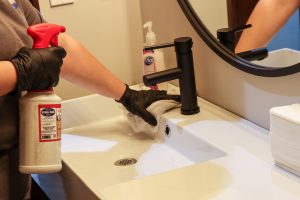
- Disinfection: Chemical-resistant gloves and eye protection.
- Floor Stripping: Slip-resistant footwear and splash protection.
- Biohazards: Full body coverings and fluid-resistant masks.
3. Slips, Trips, and Falls: The Sioux Falls Winter Reality
In South Dakota, we deal with snow, ice, and salt for a large chunk of the year. OSHA 1910.22 requires that walking surfaces be kept dry and clean.
A “Good” janitorial company just mops. A Professional company:
- Deploys Signage: Wet floor signs go out before the mop touches the floor.
- Coordinates Timing: We schedule floor work during low-traffic hours to minimize risk to your employees.
- Maintains Matting: We focus on entryways to stop the slush before it becomes a slip hazard.
4. The EPA: Killing Germs Legally
Did you know it is technically illegal to claim a product “disinfects” if it doesn’t have an EPA Registration Number?
- List N: We only use disinfectants that are EPA-registered. This is the same list that proved effectiveness against COVID-19.
- Dwell Time: The EPA label tells us how long a surface must stay wet to actually kill the germs. If a cleaner sprays and immediately wipes, they haven’t disinfected anything—they’ve just moved the germs around.
5. Why Shared Liability is Real
OSHA operates under the Multi-Employer Worksite Doctrine. This means if a cleaning vendor leaves a bucket in a dark hallway and your employee trips over it, OSHA can cite both the cleaning company and your business.
Before you sign a contract, ask for:
- A written Hazard Communication Program.
- Proof of PPE training records.
- EPA registration numbers for their disinfectants.
- Proof of workers’ comp and liability insurance.
The Optimal Prime Guarantee
At Optimal Prime Cleaning Services, we provide transparent documentation. We don’t want you to “trust” that we are compliant; we want you to verify it. From our scannable SDS posters to our 25-point inspection system, we provide the proof you need for any audit or inspection.
Don’t risk a $16,000 mistake. Visit OptimalPrimeServices.com to schedule a walkthrough. We’ll help you audit your current cleaning setup and ensure your Sioux Falls facility is safe, sanitary, and fully compliant.