Commercial floors and countertops take on dirt all day. At Optimal Prime Cleaning Services, we use neutral cleaners for the bulk of that daily work. These products sit in the middle of the pH scale, so they lift dirt effectively without damaging surfaces or being hard on the people using them.
But putting a neutral cleaner in the supply closet doesn’t make a building clean on its own. How the crew mixes and uses the product matters just as much as which product it is.
Why More Cleaner Isn’t Better
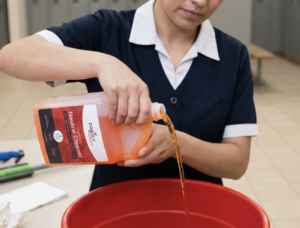 When a surface is really dirty, the natural reaction is to add more cleaner. With neutral products, that usually backfires.
Extra cleaner doesn’t break down tough dirt any better. It just leaves a residue sitting on the surface, which can actually attract more dirt. Over-pouring or mixing by eye is one of the most common mistakes we see in commercial cleaning.
Following the label and using the amount it calls for is what lets the product work the way it’s supposed to. More isn’t stronger. It’s just wasteful.
The Right Cloth Matters
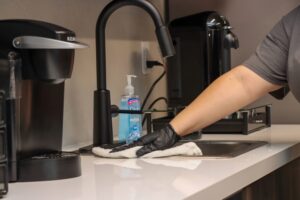
The tools make a difference too. Pairing a neutral cleaner with microfiber cloths gets better results and can cut down on the need for stronger chemicals.
Microfiber pulls up dirt more effectively than a standard cotton towel, so the cleaner and the cloth do more of the work together. That keeps the process simpler and reduces how much product you go through.
Cleaning Isn’t the Same as Disinfecting
A neutral cleaner removes dirt. On its own, it doesn’t kill germs.
Killing bacteria and viruses takes a disinfectant, which relies on an active ingredient. Some use quaternary ammonium, others use hydrogen peroxide. Whatever the product, it only works when it’s EPA-registered, used according to the label, and left wet on the surface for the full contact time the label lists. Wipe it off too soon and it hasn’t done its job.
There’s also a floor-care reason to be careful about which disinfectant gets used. Harsh, high-pH products can dull or strip a floor finish over time, while a neutral cleaner is made to clean without breaking down the finish. The goal is to handle germs without wearing out the building’s surfaces in the process.
Matching the Cleaner to the Job
 The right neutral cleaner depends on what a facility is trying to accomplish.
Enzyme-based formulas are useful for odors, but enzymes have a limited shelf life and lose strength over time, so they aren’t something to stockpile. Some cleaners are unscented, while others carry a light scent people associate with a clean space. Which one fits depends on the building and the people in it.
Whatever the product, it helps to check the results instead of assuming. An ATP meter, for instance, can measure the organic residue on a surface before and after cleaning, which turns “looks clean” into something you can actually measure.
Putting It Together
Getting real value out of a neutral cleaner isn’t about the product alone. It’s diluting it correctly, using the right cloth, matching the cleaner to the job, and knowing where a disinfectant is actually needed.
If you’d like to get more out of the products your building already uses, request a quote and Optimal Prime Cleaning Services can talk through a cleaning plan that fits your facility.
This article is provided by Optimal Prime Cleaning Services for general informational purposes only. It is not compliance or professional advice for your specific facility. For help with your situation, please consult a qualified professional or the relevant authority.