A medical office looks a lot like any other office. There’s a waiting room, a front desk, a few hallways, and some rooms with doors.
It doesn’t get cleaned like one.
Patients come through all day. Exam rooms are used back to back. Some of the people in the building are already sick, and some have weakened immune systems. A cleaning plan written for a regular office wasn’t built with any of that in mind.
That’s usually where the gap shows up. A standard commercial cleaning routine covers the trash, the vacuuming, and the surfaces that look dirty. In a clinic, a lot of what matters most doesn’t look dirty at all.
Exam Rooms Need Attention All Day
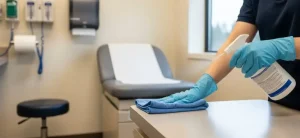 In a regular office, most surfaces can wait for the nightly cleaning. An exam room can’t wait that long. The table, counter, stool, cabinet handles, light switch, and door handle get touched by one patient after another.
In most practices, the clinical staff handle the quick wipe-down between patients, since they’re in the room and the cleaning crew usually isn’t. The cleaning company takes care of the deeper scheduled work, typically after hours. That
includes floors, restrooms, waiting areas, and a thorough cleaning and disinfection of the exam rooms themselves.
That split should be spelled out before the work starts. When nobody is sure who is responsible for what, some surfaces get cleaned twice and others don’t get cleaned at all.
The Waiting Room Needs More Than a Quick Pass
The waiting room is where sick and healthy people sit in the same chairs and use the same pen at the check-in counter. Kids put their hands on everything.
A family-practice waiting room during flu season is a good example. The chairs stay full, the front desk is busy, and armrests, door handles, and clipboards get handled over and over. None of that leaves visible dirt, so a crew that cleans for appearance can walk right past it.
Those shared surfaces need regular cleaning and disinfection whether they look dirty or not. Cleaning removes the dirt and buildup. Disinfecting with the right product, used the right way, is what reduces germs on those hard surfaces.
Disinfecting Takes More Than a Spray Bottle
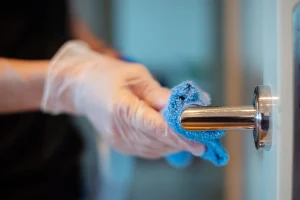 This is where medical office cleaning differs most from regular office cleaning, and it’s easy to get wrong. Spraying a surface and wiping it dry a few seconds later hasn’t disinfected it.
The surface needs to be cleaned first. Disinfectant doesn’t work well on a surface covered in dirt or residue. Then the disinfectant goes on and stays wet for the full contact time listed on the label. That dwell time is how long the product needs to do its job, and it’s the step that gets skipped most often.
The product matters, too. The CDC’s infection-prevention guide for outpatient settings calls for routine cleaning and disinfection of environmental surfaces, with
extra attention on frequently touched surfaces near patients. It also calls for EPA-registered disinfectants used according to the manufacturer’s directions, including contact time.
Our crews use hydrogen-peroxide-based, EPA-registered disinfectants rather than bleach. Whatever product is used, it should be matched to the surface and to what the practice’s own infection-prevention policy calls for. You can read more about our commercial disinfection services.
Keeping the Dirty Areas Away From the Clean Ones
Cross-contamination is one of the quieter risks in a clinic. The cloth that wiped down a restroom shouldn’t end up on an exam room counter.
A crew set up for medical work keeps those areas separate, usually with color-coded microfiber cloths and dedicated tools for restrooms. It’s a simple system. It only helps if it’s followed every time, on every shift, by everyone on the crew.
Where the Cleaning Crew’s Job Ends
A cleaning company that understands medical offices will be clear about what it does and doesn’t handle.
The cleaning crew takes care of the environmental side: surfaces, floors, restrooms, waiting areas, and the disinfection that goes with them. Regulated medical waste, including sharps containers and biohazard bags, is handled by the practice and its licensed medical waste service, not the cleaning crew.
Patient privacy is part of this, too. Our crews are already trained to work around papers left on desks. In a medical office, that habit matters even more. Charts, paperwork, and equipment should be left where they are, and nothing should be opened or read.
Winter Is Hard on Clinic Entrances
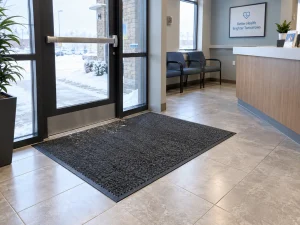 Sioux Falls clinics deal with the same winter every other building does. Salt, ice melt, and slush get tracked straight through the front door.
In a medical office, that wet, salty entrance is a slip risk right where patients walk in, including patients who may already be unsteady on their feet. It also leaves a white film on hard floors that regular mopping doesn’t always remove. Keeping entrance mats and floors under control through the winter is part of the job, and heavily salted floors may need hard floor cleaning beyond the routine.
The Parts Nobody Sees
Most of what makes a medical office properly cleaned happens where no one is watching. It’s the disinfectant left wet for the full contact time, the restroom cloth that never goes near an exam room, and the waiting room armrest that got disinfected even though it looked fine.
If you manage a clinic or medical practice in the Sioux Falls area, request a quote from Optimal Prime Cleaning Services. We’ll put together a cleaning plan built around how your practice actually runs.
This article is provided by Optimal Prime Cleaning Services for general informational purposes only. It is not medical, legal, or compliance advice. Always follow current CDC and OSHA guidance, your practice’s infection-prevention policy, and the manufacturer’s label directions for the products used in your facility.